


As multinational organisations become increasingly interconnected, the gap between global ambition and local execution has never been more important. Giovanna Rosato, Business Practices Director at MSD Italy, examines how legal and compliance leaders can navigate conflicting standards while maintaining both consistency and flexibility.
There is one truth that anyone working in-house in a multinational learns early on: global alignment is a necessary promise, but rarely a linear one. On paper, Global brings order, consistency and control. In reality, that design must contend with different markets, different rules, different regulators and different levels of organisational maturity. It is in this gap between central architecture and local reality that one of the most sophisticated challenges facing today’s General Counsel or Head of Legal & Compliance or Legal or Compliance Director (“GC”) truly lies. No longer merely a corporate lawyer, the modern GC has become a point of connection between systems, interests, priorities and responsibilities that do not always speak the same language.
The global paradox: being inclusive without becoming abstract
Global legal and compliance functions operate within a complexity that is very real, not theoretical. They are asked to build frameworks capable of holding across multiple jurisdictions, anticipating risk, ensuring internal coherence and protecting the organisation as a whole. It is an exercise in synthesis that is both difficult and, by those looking at multinationals from the outside, often underestimated. And yet this is precisely where the paradox begins: in attempting to be applicable everywhere, the global framework risks becoming either too detailed to be realistically implemented or too abstract to be truly useful. In both cases, the issue is not the quality of the intention, but the distance between principle and execution.
Far too often, that analysis is carried out without any meaningful and timely involvement of individual countries. That is a methodological error before it is an organisational one. Country teams are the ones that understand not only local requirements, but also regulatory expectations, market practice, functional maturity, technological constraints and the wider operational environment in which those rules will need to live. When Global standardised without listening, the risk is not merely that it produces inefficient policies. The real risk is that it creates waivers, workarounds, duplications and, in some cases, genuine grey areas in compliance.
Beyond policy: the real test lies in tools, platforms and systems
And yet the most revealing stress test is rarely the policy itself. It is the systems. The tools. The platforms that are supposed to translate the framework into day-to-day operations. This is where many global models reveal their limitations. Those selecting vendors, software or implementation models at central level do not always engage with local teams to assess whether a system is truly capable of incorporating the legal and regulatory requirements of each country. And yet it is precisely in these details that the resilience of the model is determined: a missing section, an inflexible workflow, a non-configurable field or a document logic misaligned with the local framework can turn a global solution into a daily obstacle.
If a multinational genuinely wants to avoid the proliferation of parallel systems, manual controls and compensating solutions, its technology architecture must be designed with flexibility from the outset. It must be capable of being tailored without losing coherence. It must enable local legal and compliance functions to meet their own regulatory obligations using the tools made available by Global, without forcing them to build a second layer of management outside the system. When that does not happen, the cost is always the same: more expense, less traceability, less efficiency and, paradoxically, less control.
From framework to execution: what Global teams must do to truly support the countries
There is another point that, in the most mature organisations, makes all the difference: Global should not limit itself to issuing internal rules; it should also make their application possible. That means equipping country teams with operational guidelines, templates, training materials, planning tools and even support for presentations to local boards or committees. This is not an optional extra. It is what transforms a framework from a statement of principle into infrastructure that can actually be used. Especially in those contexts where global projects are layered onto local realities already under pressure from the demands of day-to-day business and the priorities of the business units.
“International compliance is not built only by writing better rules, but by creating organisations that know how to listen better, translate better and coordinate better.”
Corporate governance and local accountability: when the global model is not enough
The issue becomes even more sensitive when corporate governance enters the picture. In multinationals, responsibilities, reporting lines and decision-making processes are often designed at global or regional level according to a logic of efficiency and coordination that is entirely understandable. But corporate governance does not automatically coincide with legal governance. And it is in that gap that some of the most complex frictions emerge. An organisational chart that is perfectly well designed from a corporate perspective may still be insufficient, on its own, to govern contexts in which the law assigns specific obligations to local entities, bodies or functions.
Cybersecurity makes this especially clear. In large organisations, cyber governance is often structured along Global, Regional or Cluster lines, with responsibilities distributed across multiple levels. From a business standpoint, that is a rational choice. From a regulatory standpoint, it may not be sufficient. In the Italian context, the implementation of the NIS2 Directive through Legislative Decree No. 138/2024 confirms that certain obligations remain firmly anchored at local level: from governance to compliance activities, from planning to communications with the competent authority. The point, then, is not to oppose the central model to the local one, but to recognise that the corporate structure cannot obscure the ownership of legal responsibility. That distinction becomes essential, particularly when speed of execution and clarity of interlocutors are themselves integral to compliance.
Where genuine coordination between Local and Global is missing, and where central functions are not held accountable for the local impact of organisational decisions, the risk becomes very real: there may be no truly responsive interlocutors when rapid decisions are needed, roles must be aligned, processes adapted or communications with authorities managed. In other words, Global may design the architecture, but without a shared local governance layer it risks leaving exposed the very points at which legal responsibility ultimately crystallises.
The role of the local GC: not merely a recipient of policy, but a strategic partner to Global
None of this, of course, should be read as a one-sided burden on Global. Local General Counsel also have a critical role to play, and one that is increasingly strategic. They must be able to engage with central functions in a way that is continuous, candid and constructive. They must surface regulatory developments, enforcement trends, operational constraints and practical implications early enough to prevent a solution designed elsewhere from becoming ineffective or incomplete. In other words, the local GC cannot simply react. They must help shape direction.
This is where, in my view, the true maturity of the function is tested. The dialogue between Local and Global should not collapse into a dynamic of escalation or request. It should become a continuous exchange of solutions, sensitivities, priorities, approaches and good practices. Those working within the countries often see before anyone else where a framework is likely to stall, which steps will fail in practice and which tools will require intelligent adaptation. But that body of experience creates value only if it is shared in a structured, non-defensive way, with a mindset of building rather than resisting. Many of the most successful evolutions of global models are born precisely from local insights that prove capable of becoming common assets.
Final reflections
For those working in-house, the real question is not whether Global is right or whether Local has a deeper grasp of reality. The real question is whether the organisation is mature enough to turn that tension into method. A global framework holds when it defines strong principles, yet leaves room for governed adaptability; when it listens before it standardises; when it builds flexible tools; when it supports implementation with practical guidance; and when it recognizes in local functions not a peripheral control point, but a valuable form of regulatory and organisational intelligence.
For those observing multinational companies from the outside, this is perhaps one of the least visible yet most decisive truths: international compliance is not built only by writing better rules, but by creating organisations that know how to listen better, translate better and coordinate better. At a time when enforcement, technology, governance and accountability are all evolving at increasing speed, the General Counsel becomes the point of balance between uniformity and context, between central ambition and local feasibility. And it is precisely in that ability to hold vision and reality together that the most sophisticated quality of legal leadership can now be recognised.
Be part of a growing global community committed to advancing in-house legal leadership.
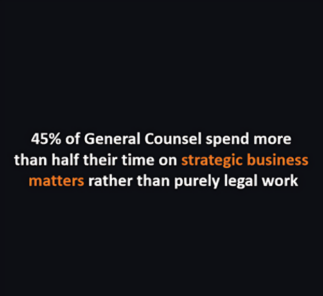
The role of the General Counsel has been evolving for years, but how much time do today’s legal leaders actually spend on strategy? For many...
Learn more about New research reveals how General Counsel really spend their time

Markus Warmholz, Head of Corporate & International Legal Affairs and Legal Operations at Hartmann Group in Germany, highlights overlooked legal pitfalls that can derail even...