

Ivan Casella, Head of Legal, Compliance & Governance at Brugola OEB Industriale S.p.A. in Italy, considers the balance at the heart of modern legal leadership: helping the business move forward while retaining the independence to challenge it when necessary.
For years, the evolution of the General Counsel has been described as a journey from legal adviser to business partner.
That evolution is real. Legal expertise remains essential, but it is no longer enough. A modern General Counsel is expected to understand the business, contribute to decision-making and help the organisation pursue its objectives while managing legal risk.
But becoming a business partner does not eliminate another fundamental responsibility: the General Counsel must also be a gatekeeper.
These roles are different, but complementary. The business partner helps the organisation make better decisions and take intelligent risks. The gatekeeper protects the organisation when those risks cross legal, ethical or governance boundaries.
What, then, makes a General Counsel a genuine business partner?
I believe it requires at least four characteristics.
1. An ownership mindset
The biggest difference between private practice and an in-house role is not technical. It is psychological.
An external lawyer advises a client. An in-house lawyer belongs to the organisation.
Your colleagues’ problems become your problems. You live with the consequences of your advice. If a transaction is delayed, a customer is lost or an operational process becomes unnecessarily complicated because of the solution you proposed, you experience those consequences alongside everyone else.
A business partner therefore does not simply identify legal issues. They take responsibility for helping the organisation find workable solutions.
2. Understanding the business
Good legal advice requires understanding the context in which it will operate.
That means developing genuine curiosity about subjects lawyers are not always trained to study: operations, finance, margins, customers, technology, manufacturing processes, organisational dynamics and business strategy.
The objective cannot simply be to identify the technically safest solution. It must be to help the company achieve the best possible business outcome within an acceptable legal and ethical framework.
The closer Legal gets to the reality of the business, the more valuable its advice becomes.
3. Comfort with intelligent risk-taking
Business is inherently about risk.
Companies create value by investing, negotiating, hiring, innovating and entering new markets despite uncertainty. A General Counsel who tries to eliminate every legal risk will inevitably become a brake on the organisation.
A business partner therefore asks different questions:
What is the real risk? How likely is it? What would the consequences be? How can we mitigate it? And is it worth taking?
The General Counsel must translate legal complexity into information management can actually use. Decision-makers rarely need twenty pages explaining why an issue is complicated. They need to understand their options.
4. A preventive approach
A genuine business partner does not only solve problems after they arise.
Because Legal operates inside the organisation, it can identify recurring issues, improve contractual processes, strengthen governance, resolve disagreements before they become disputes and contribute to strategic decisions while they are still being shaped.
The best legal problem is often the one that never becomes a legal problem.
“A compass does not choose the destination. Management and the Board do that. Nor does it prevent the organisation from moving quickly or taking difficult routes.”
Being a business partner, however, cannot mean automatic alignment with management.
The General Counsel’s ultimate duty is to the organisation itself – not to an individual executive, business function or shareholder.
There will therefore be situations where protecting the business means challenging it.
The General Counsel must be prepared to question decisions that cross legal or ethical boundaries and escalate concerns where necessary.
This requires independence, credibility and personal integrity. Commercial pressure, conflicting interests and legal uncertainty often create grey areas in which remaining silent is easier than speaking up. That is precisely where the gatekeeper role matters most.
As much literature confirms, I increasingly see the General Counsel as one of the organisation’s compasses.
A compass does not choose the destination. Management and the Board do that. Nor does it prevent the organisation from moving quickly or taking difficult routes.
Its purpose is to ensure that, under pressure and uncertainty, the company does not lose its direction.
The most effective General Counsel therefore knows when to facilitate, when to challenge and when to stop.
Commercial pragmatism without independence can become acquiescence. Legal rigour without business understanding can become bureaucracy.
Help the business move fast – but never let it lose its way.
Be part of a growing global community committed to advancing in-house legal leadership.

In the legal profession, the term “personal brand” often meets with suspicion. It sounds like self-promotion. It feels at odds with the substance, discretion, and...
Learn more about WEBINAR: Personal branding for Legal: influence without self-promotion
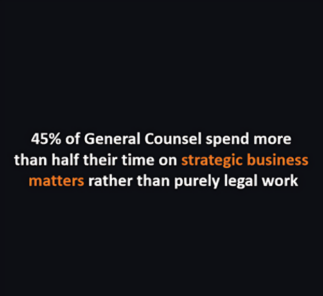
The role of the General Counsel has been evolving for years, but how much time do today’s legal leaders actually spend on strategy? For many...
Learn more about New research reveals how General Counsel really spend their time

Head of Legal, Compliance and Governance Affairs
Brugola O.E.B. Industriale S.p.A.
Italy